When the report register stays empty for months, it is rarely because nothing is happening in the field. The anomalies are there, and nobody files them. For a safety manager or an HSE coordinator that means working from an incomplete picture, because prevention depends on information from the field that no document can replace. For that information to arrive, workers need to be able to report without effort, and to know that the report will be read.
Planned work and real work
Risk assessment produces a photograph of the activity as it was designed: a set of environments, tasks, equipment and specific preventive measures. On site, the same activity has different shades. Reality adds variations that can be invisible at the analysis stage: a machine under maintenance is replaced by a model with different controls, a supplier delivers material in heavier packs than usual.
This distance between planned work (work-as-imagined) and real work (work-as-done) is not an irregularity to be sanctioned. It is a structural dynamic, widely documented in the resilience engineering literature. For whoever manages safety, the critical point is that the discrepancy is visible only to the people working on site, and that no document audit and no periodic inspection can catch the anomaly at the moment it appears.
Two reasons reports stop coming
The pattern is familiar: the reporting form exists, and it stays empty. It rarely depends on the workers. More often it depends on how inconvenient reporting is, and on what happens afterwards.
- The procedure: if reporting an anomaly takes more time and effort than living with it, the report is not filed. Collecting a paper form, filling it in at the end of the shift and handing it over in person is already obstacle enough, and many observations are lost before reaching anyone who can act on them.
- The feedback: someone who reports an anomaly and hears nothing about the outcome tends not to do it again. The channel stays open, and workers stop using it.
Both points have a normative counterpart. ISO 45001 clause 5.4 requires the organization to determine and remove obstacles and barriers to participation, and to minimize those that cannot be removed. The standard lists failure to respond to worker input, language and literacy barriers, and practices that discourage participation among the examples. An empty register is therefore a finding, and not a cultural trait of the workforce.
Who reports, and what the rules require
Reporting is first of all a duty of the worker. Article 13 of Directive 89/391/EEC requires each worker to immediately inform the employer and/or the workers with specific responsibility for safety and health of any work situation they have reasonable grounds to consider a serious and immediate danger, and of any shortcomings in the protection arrangements. National legislation across the Member States transposes this duty, with variations in the sanctions and in the role assigned to supervisors.
Worker participation then follows a second, collective path. Article 11 of the same directive requires employers to consult workers and their representatives and to allow them to take part in discussions on health and safety matters, with the right to make proposals.
For organizations running a management system, ISO 45001 goes further than consultation. Clause 5.4 distinguishes consultation, meaning seeking views before a decision, from participation, meaning involvement in the decision itself, and it requires the participation of non-managerial workers in hazard identification, in the determination of controls and in incident investigation.
Outside the European framework, the US rules converge on the same mechanism from the recordkeeping side. Under 29 CFR 1904.35, an employer must establish a reasonable procedure for reporting work-related injuries and illnesses, and the rule states explicitly that a procedure is not reasonable if it would deter or discourage a reasonable employee from reporting accurately. Three different regimes, one shared conclusion: the quality of the channel is the employer’s responsibility.
The practical consequence for site supervisors is direct. They are usually the first to receive a report, and the way they handle it shapes how much the workforce trusts the channel.
Three indicators for reading participation
The total number of reports, on its own, is not sufficient to assess the level of worker participation. Whoever manages reports can take the analysis further with three indicators, which can be calculated from the data collected, whatever tool is used.
- Distribution by site or department: highlights differences between areas of the organization. A site or department with few reports, or none, compared with the others is worth investigating, to verify whether the reporting process is genuinely accessible and used.
- Time to first response: measures the days between submission and pick-up, that is the first change of state. A prompt response helps sustain worker engagement and gives continuity to the process.
- Effective closure rate: compares reports closed with a corrective action or a documented intervention against the total number of closed reports. It has to be read together with the closure reasons, since some reports are legitimately closed without action because they are duplicates or out of scope. A low value becomes a warning sign when closures without follow-up concern real issues.
These belong to the family of leading indicators, because they monitor the preventive capacity and the responsiveness of the organization, adding to injury rates (lagging indicators) a reading of the activities that contribute to preventing events. ISO 45001 clause 9.1 leaves the choice of what to monitor to the organization, which makes participation metrics a legitimate and auditable part of performance evaluation.
How 4HSE handles field reports
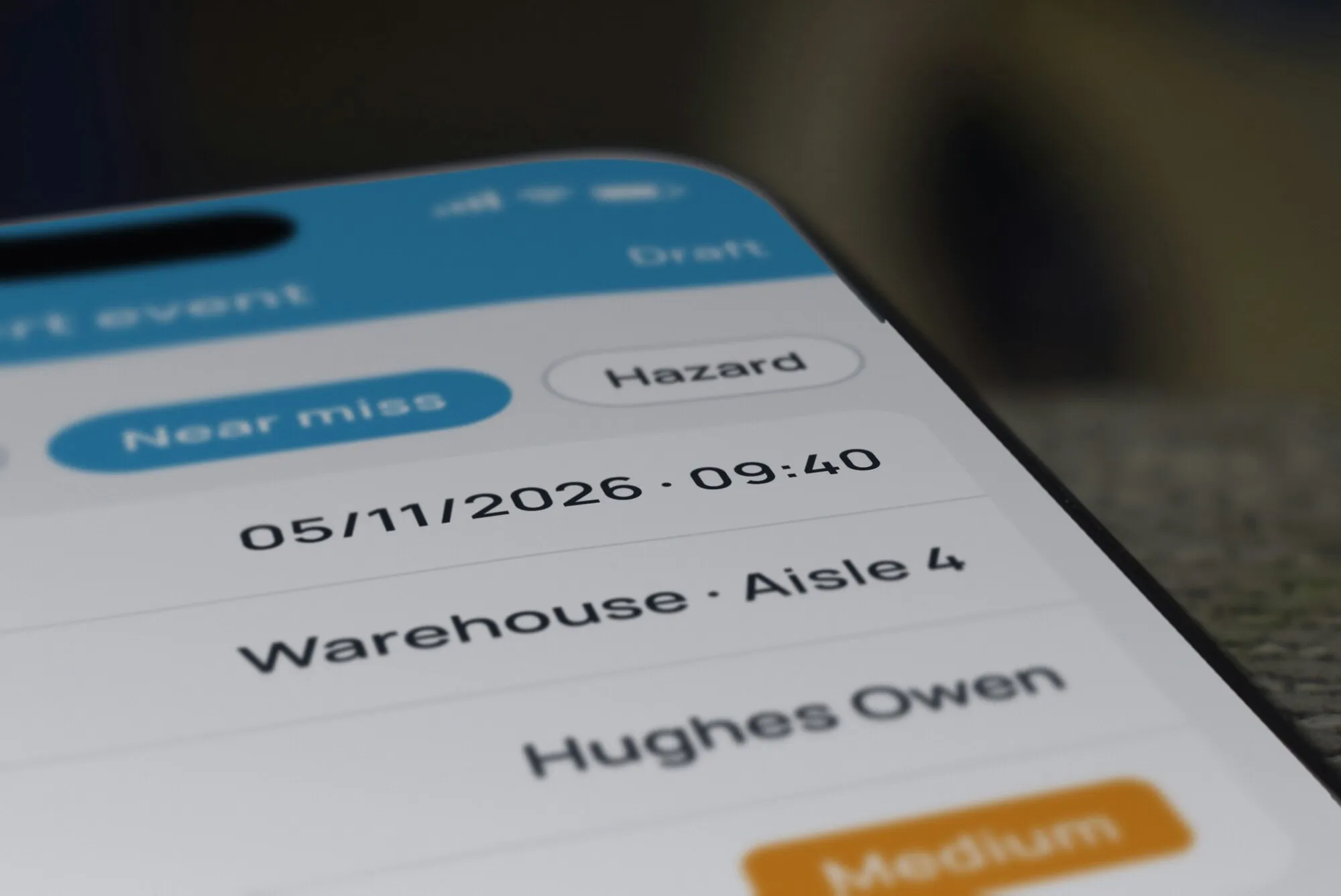
With 4HSE, a worker can submit a report directly from the mobile app, at the moment an anomaly or a situation requiring attention is observed.
The app allows the event to be classified according to the categories defined in the company register: procedural nonconformities, equipment failures, near misses, maintenance or inspection requests. A photograph taken from the app can be attached, to document the situation and give a concrete reference to whoever will assess it.
Once submitted, the report enters the 4HSE event register. The safety manager, the supervisor or the technical office can review it, assess its priority and decide how to proceed: opening a corrective action, scheduling maintenance work or revising the preventive measures.
Handling continues inside the platform. The person who filed the report can consult their own history from the app and follow its progress through the different states of the case.
Device notifications keep the worker informed of updates, while notes make scheduled interventions and adopted measures visible. The report does not end with its submission: it stays connected to the handling of the event and to the actions that follow.
In summary
A report register that stays empty is data to analyze, like any other safety indicator. Workers report when they can do so without effort and when they see that the report leads somewhere. Participation indicators make it possible to track both conditions over time and to act before incidents bring the problem to light.
References and further reading
Institutional and scientific sources
- Council Directive 89/391/EEC (OSH Framework Directive): Article 11 (consultation and participation of workers), Article 13(2)(d) (worker duty to report serious and immediate danger and shortcomings in the protection arrangements).
- ISO 45001:2018, Occupational health and safety management systems: clause 5.4 (consultation and participation of workers, removal of obstacles and barriers), clause 9.1 (monitoring, measurement, analysis and performance evaluation).
- 29 CFR 1904.35, Employee involvement: reasonable reporting procedure.
- Hollnagel E., Safety-I and Safety-II: The Past and Future of Safety Management, Ashgate, 2014. The reference text of resilience engineering on the distance between work-as-imagined and work-as-done.
More on 4HSE