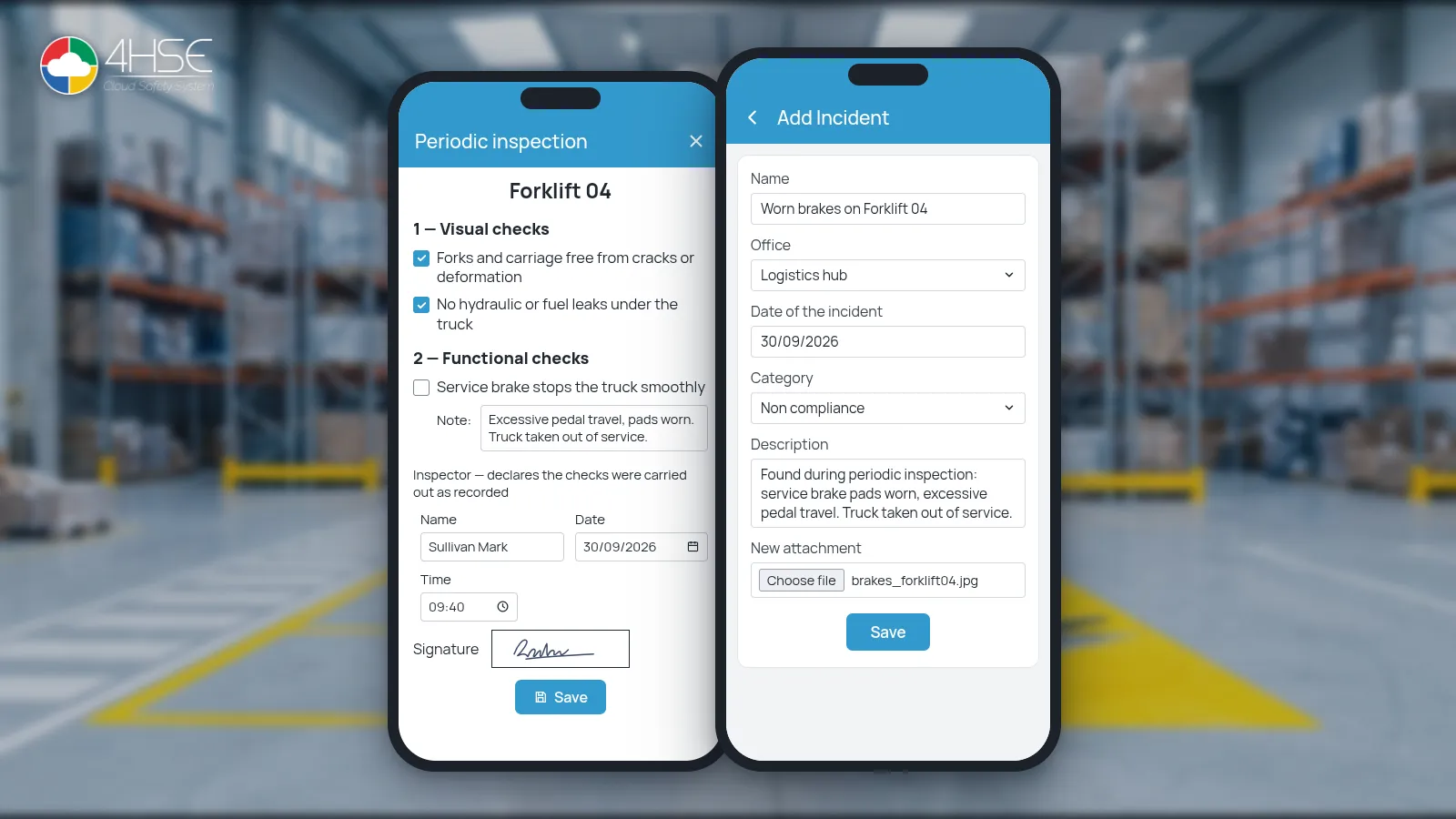
Operational compliance is the layer of evidence produced in the field: who ran a check, when, with what outcome, and what happened next. Digitizing it means the record is created where the event occurs, rather than reconstructed at a desk the following day.
There is an inexpensive way to establish whether an operational system works, and it is to look at the record that closes each activity. A periodic inspection, an equipment check, an emergency drill are assigned requirements with their own due dates, exactly like a training course or a medical examination. The record that certifies execution is the unit of measure of operational compliance, and ISO 45001 says as much in clause 8.1.1, which asks organizations to maintain and retain documented information sufficient to give confidence that processes were carried out as planned.
The limits of manual field work
A spreadsheet can create the impression of controlling scheduled deadlines, and it falls short when it has to carry daily action.
- The same data entered three times. The HSE specialist or the supervisor runs the walkthrough with a paper pad, returns to the office, transcribes into a file, scans the report and files it on a network drive. Every walkthrough generates three passes over the same information. The time lost in that triple handling is the first figure to calculate before selecting software: monthly walkthroughs multiplied by the minutes spent re-entering data each time.
- Delayed response. When an inspection finds a forklift with worn brakes, a note written on paper can sit on a desk for days while the hazard stays on the floor.
- Scattered actions. Findings raised during walkthroughs are chased through email, messages and separate files. For the HSE coordinator, establishing which ones are genuinely closed becomes an exercise in reconstruction.
Why the closing record is the unit of measure
When a control activity is configured as an assigned requirement, with its own due date and its own checklist, execution has two possible outcomes and neither leaves room for interpretation.
If the check ends with no findings, the operator ticks the items, attaches the evidence collected on site, signs, and the closing record is issued. From that moment the next due date is calculated and the activity counts as covered.
If the check finds a problem, the sequence stops where it should stop. A nonconformity opens against the resource that produced it, carrying the evidence collected, and the closing record is withheld. The activity keeps appearing as uncovered until the situation is resolved and the record is produced.
This is where the two levels of compliance meet. The missing record belongs to the operational level: it is the observation that an assigned requirement is not currently met. The decision on how to remedy it, an additional control measure, a rescheduled maintenance, a revision of the planned protocol, belongs to the structural level, because it changes the model, and it is taken by whoever answers for it. ISO 45001 draws the same line in clause 10.2, where investigation, cause analysis and corrective action are separate steps from the initial reaction to the event. The distinction is developed in Structural and operational compliance in HSE software.
The practical gain is that the nonconformity becomes visible by construction. Nobody has to notice anything: the activity stays uncovered and keeps appearing among those still to close.
What makes field execution sustainable
- Separate capture from classification. Someone reporting a near miss should be able to do it in thirty seconds, describing what they saw and attaching evidence. Technical classification, category assignment and the opening of the treatment happen downstream, handled by whoever holds the role. Asking a field operator for a regulatory category moves onto them a task that is not theirs, and it reduces the number of reports. Clause 5.4 of ISO 45001 is explicit on this point: participation is expected from non-managerial workers, which only happens when reporting costs them almost nothing.
- Measure responsiveness, not only coverage. The structural level monitors static indicators, such as the share of workers with training assigned. The operational level needs dynamic ones: the share of planned inspections actually executed and documented, the time between a nonconformity being recorded and being closed, and the near miss reporting rate per site, which is a more reliable index of safety culture than the injury count.
What to test during an evaluation
During selection, the HSE office dashboard is the output rather than the proof. The proof is the point where the data is created. It is worth starting the demo from a supervisor’s phone: run a check with its checklist, issue the closing record, then repeat the same check with a negative outcome and observe what follows. Where the nonconformity appears, who receives the notification, what stays uncovered and for how long. The comparison between the two paths says more than any feature list.
Three questions are worth carrying into that session.
Does the return loop from the field close? A recurring finding raised on site should be able to change the requirements planned for that context without anyone rebuilding the data by hand. If that step needs a technical intervention, the loop stays open.
How deep does configurability run? Every vendor uses the word. Asking to create a requirement that does not exist yet, live, and to associate it with a work context, shows the real cost: how long it takes, and how it connects to information the system already holds.
What does growth cost? Opening a site, entering a new country or absorbing a regulatory change has a price in time and in money. A new configuration and a new development contract are different answers, and the difference separates an architecture that adapts from one that only claims to. The point is developed in Configurable by design: what a safety management system needs from its software.
The full path from the field to final documentation, with the tools that compose it, is described in Field Prevention Management: Tools and Operational Workflows.
How 4HSE handles documented execution
In 4HSE, control activities such as inspections, equipment checks and practical drills are configured as preventive actions with their own due dates, and can carry a checklist and structured forms. The operator runs them from a smartphone or tablet, ticks the items, attaches photos and notes collected on site, signs in app, and issues the closing record at the moment the activity ends, without deferring the entry to the office.
When the outcome flags a problem, the nonconformity enters the events registry linked to the originating resource and to the people involved, and the closing record is withheld: the activity keeps appearing among those uncovered. The notification reaches the responsible person in real time, along with the assignee and anyone entitled to observe, carrying the information needed to decide. Activating an additional measure or rescheduling a planned activity is an explicit choice made by whoever answers for it, and from that point it sits among activities with a due date like any other.
Data collected in the field feeds the same archive the HSE manager reads for the overall picture, and can be exported in standard formats for analysis carried out in other systems.
References and further reading
Standards and institutional sources
- ISO 45001:2018, Occupational health and safety management systems. Clause 8.1.1 on documented information for operational control, clause 5.4 on consultation and participation of workers, clause 10.2 on incident, nonconformity and corrective action.
- OSHA Safety Pays, a set of awareness tools for estimating the cost of workplace injuries. It creates no legal obligation, and its average claim costs come from National Council on Compensation Insurance data for policy years 2015 to 2017.
More on 4HSE
- Field Prevention Management: Tools and Operational Workflows
- Structural and operational compliance in HSE software
- Configurable by design: what a safety management system needs from its software
- App and HSE on the move
- Events registry
- Non-conformities
- HSE audit
- Notifications
- Recording injuries, incidents, near misses and nonconformities — product documentation