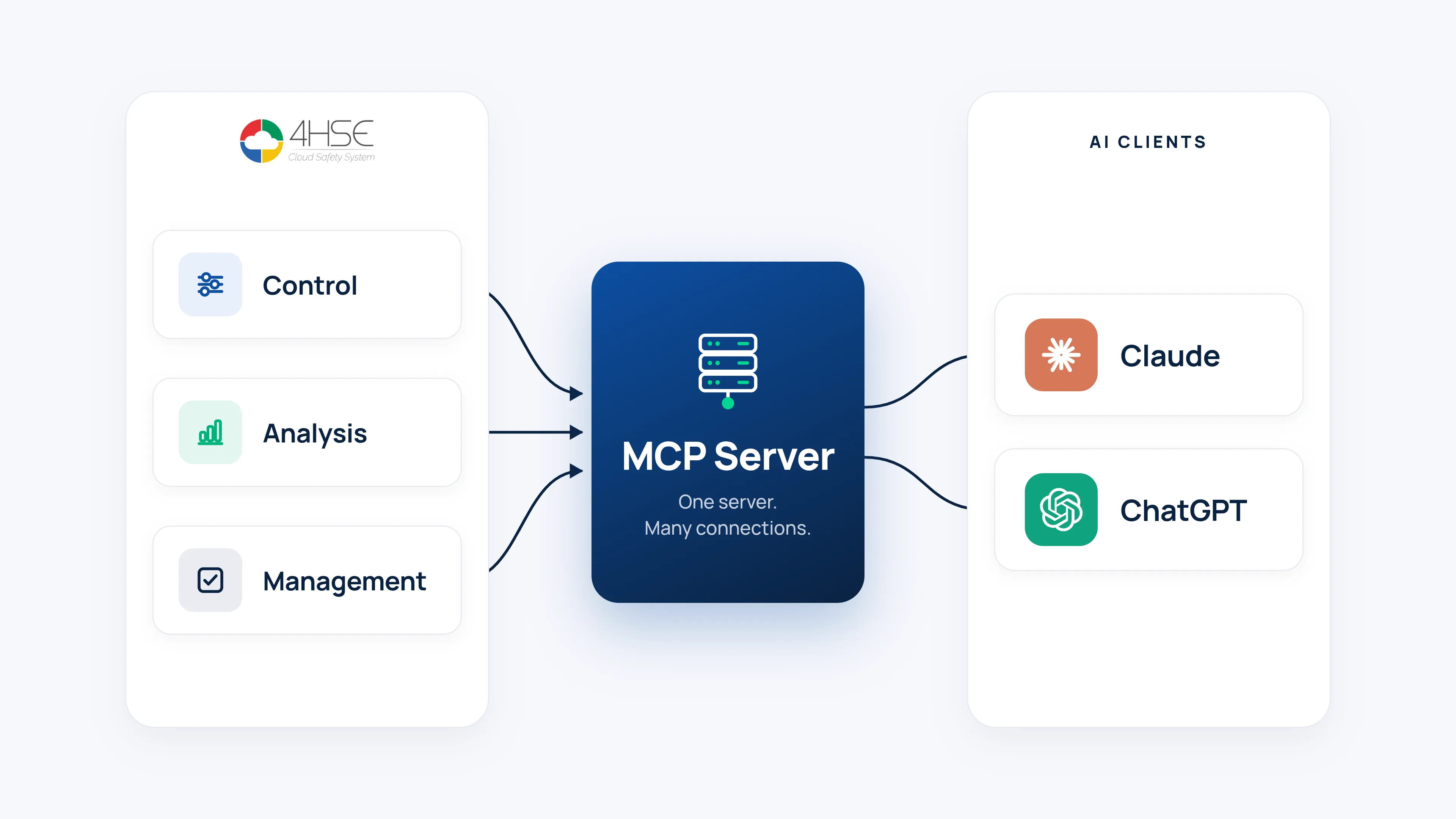
Artificial intelligence is creating new ways of interacting with company data, offering optimisation opportunities in the occupational safety sector as well. One of the most interesting technological developments in this area is the Model Context Protocol (MCP), an open standard (i.e. a public, shared protocol) introduced at the end of 2024. In practical terms, this system makes it possible to connect the virtual assistants we use every day, such as ChatGPT or Claude, directly to an external application. This way, you can consult and process the software’s data simply by talking with the assistant.
In just over a year, the MCP standard has become a benchmark adopted by the leading model developers worldwide, such as OpenAI, Google and Microsoft.
In this scenario, 4HSE has released its own MCP server, allowing users with an active account to interact with the data stored in the platform.
What the MCP server allows you to do
The main benefit of adopting the MCP standard is immediate access to company information. While 4HSE already provides advanced tools such as the deadline planner, summary tables and dedicated compliance monitoring filters, the AI integration lets users query the system in natural language. You can quickly obtain reports, retrieve specific information and carry out targeted operations.
Examples of requests the system can handle today include:
- Checking the compliance status of projects and sites: provides an immediate overview or lets you look up specific records through requests such as “Give me an overview of the safety status of project X”, or “Show me the deadlines for the Milan site”.
- Configuring job roles and training requirements: reduces the data-entry steps needed to link courses to the relevant job roles, translating commands such as “Create the Electrician job role at the Workshop site with required action Fire safety course”.
- Profiling and onboarding people: lets you set up a new person’s record, assigning site, job role, role and training obligations in a single interaction, as in “Profile Giovanni Bianchi at the Milan site, job role Warehouse worker, role RSPP, he needs to take the Fire safety course”.
- Scheduling activities: makes it possible to plan prevention action sessions directly from the AI client, using instructions such as “Schedule the First aid course for Luca Verdi on 15 May 2026 at 9:00 AM”.
The scope of data accessible through the protocol includes worker records, training history, certificate deadlines, equipment, roles and the mapping of work environments. Incident data, risk registers and billing information are instead excluded from the information flow. The server currently guarantees full compatibility with the main AI clients that support the standard.
Data flow management and user responsibility
Integrating artificial intelligence systems into occupational safety management requires a rigorous analysis of cybersecurity and personal data protection aspects.
The MCP server operates exclusively through the authenticated user’s token: this means the AI assistant can only access the information the user is already authorised to view within the software. The platform does not transmit data autonomously or in bulk; the transfer takes place only when the user submits a specific question in the AI client.
Once the information is retrieved by the MCP server, it enters the conversation context to be processed by the AI assistant. From that point onwards, data processing depends on the contract the user has signed with the AI model provider.
The role of the software tool and professional judgement
Adopting the MCP standard simplifies access to information for those managing safety in complex organisations, with multiple sites or numerous work locations, making it possible to cross-reference operational data through text requests.
Automation supports the information-gathering phase, but it does not replace the professional’s role in decision-making activities. Assessing the relevance of deadlines, defining intervention priorities, coordinating with clients and suppliers, and planning corrective actions remain the responsibility of the consultant or HSE manager.
How to activate the connection and what comes next
To use the MCP server you need an active account on the platform. The references and endpoints to configure the connection with your AI client are available in the dedicated documentation.
Alongside the MCP integration, a native AI chat is currently being tested and will be available directly within the platform. The built-in assistant will let you consult operational data, obtain regulatory information and access the software’s main features through natural language requests, without going through external applications.
The full documentation on the AI features is available here.