Near miss management: why it’s becoming a global compliance requirement
Across industries and jurisdictions, occupational health and safety standards are converging on a common principle: preventing accidents before they happen. Near miss reporting — once considered a voluntary best practice — is increasingly expected by regulators and standards bodies. ISO 45001 requires it as part of a proactive safety management system, while authorities like OSHA and the EU Framework Directive 89/391 strongly encourage it as an extension of their general prevention principles.
Organizations that do not adopt systematic near miss management risk missing the early warning signs that precede serious workplace incidents — and falling behind evolving compliance expectations.
The evolving regulatory landscape
International safety standards increasingly push companies to go beyond reactive accident reporting. ISO 45001 requires organizations to identify hazards and assess risks proactively, including the investigation of near misses and other incidents (clause 10.2). Other frameworks, while not mandating near miss reporting directly, establish general prevention duties that naturally lead organizations toward structured near miss programs.
Whether driven by certification requirements or regulatory best practices, the expectations converge on three fundamental phases:
Timely reporting: implementation of accessible channels that allow workers to report risk situations in an organized manner. Root cause analysis: systematic investigation of events to identify underlying causes and prevent the recurrence of dangerous patterns. Documentation of preventive measures: adoption of concrete corrective actions, with rigorous documentation to demonstrate compliance during audits and inspections.
Digitizing near miss management with the 4HSE app
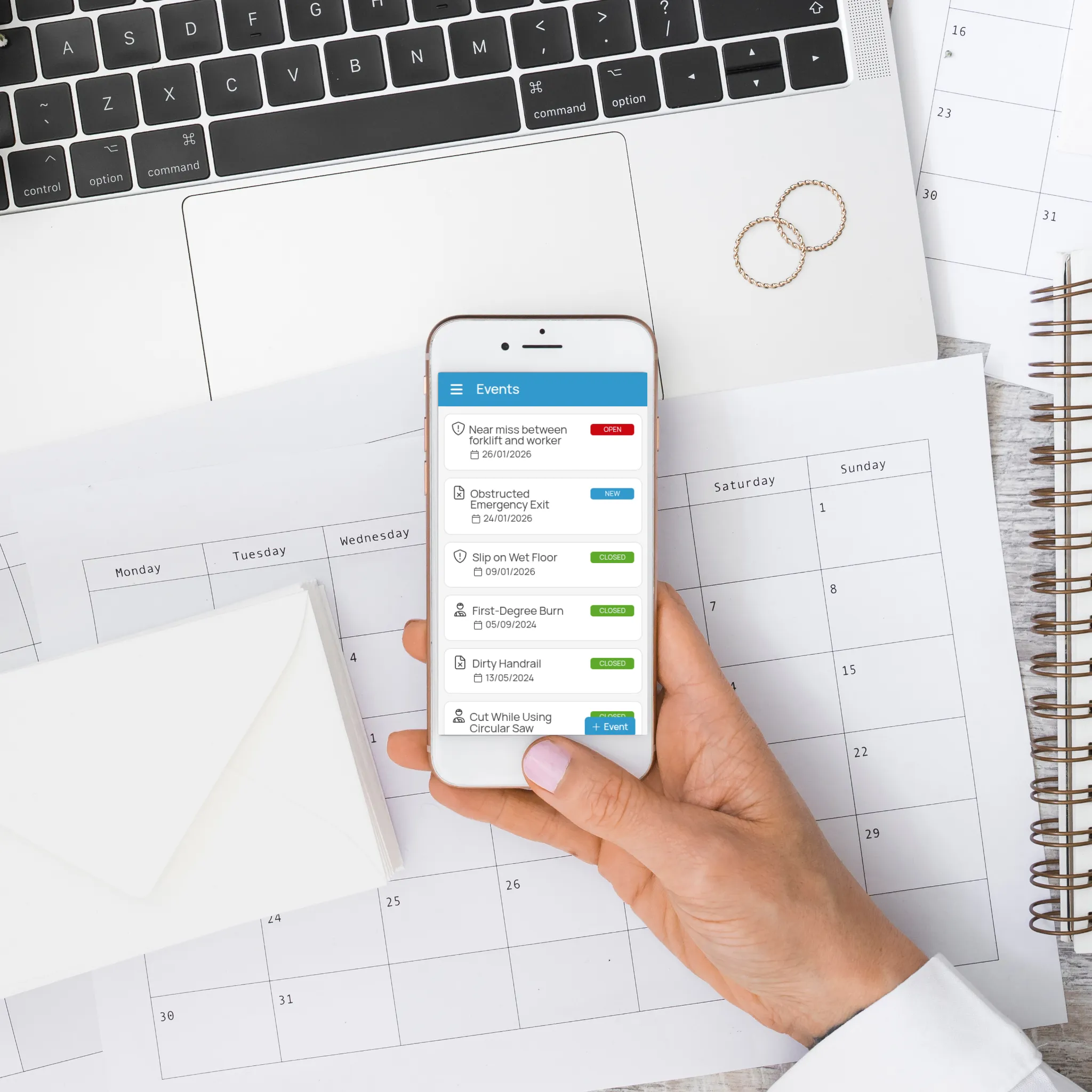
As compliance expectations grow, the digitization of safety workflows represents concrete support for HSE managers. The 4HSE platform provides workers with an immediate tool for reporting events and hazardous situations: the mobile application.
The app transforms reports into immediately available data, overcoming the limitations of paper-based management, which can be difficult to archive and analyze at scale.
How reporting works
Report management takes place through a defined workflow:
Event reporting: the worker, via the app, can describe the hazardous situation and attach photographic evidence. Notification to responsible parties: the system automatically sends a notification to the relevant safety managers. Management workflow: each report is saved within the 4HSE platform, where managers can review and manage it directly from desktop to plan the necessary preventive measures.
This system guarantees full traceability of information, facilitating compliance management and ensuring documentation is readily available for regulatory audits.
Participatory safety: the value of an interconnected system
Meeting modern safety standards requires a shift in HSE management — from passive information collection to active monitoring. An interconnected digital tool transforms compliance into an opportunity to directly involve workers, giving them the means to actively contribute to workplace safety.
The adoption of interconnected digital solutions enables organizations to engage workers in continuous improvement, building a shared safety culture that measurably reduces incident rates.